Overall, I feel like I did well on this unit's test. I knew the material well, but there were a lot of questions to answer within the hour, so I did not have time to work some math problems or double check any of the answers I was unsure about. Hoping for the best.
Time Management During Tests
Showing posts with label Electronic Structure and Periodic Trends. Show all posts
Showing posts with label Electronic Structure and Periodic Trends. Show all posts
Sunday, March 6, 2016

Saturday, March 5, 2016
Quantum Numbers
There are 4 quantum number for each specific electron.


- Principle Quantum Number
- Angular Momentum Number
- The Magnetic Quantum Number
- The Spin Quantum Number

Thursday, March 3, 2016
Ionization Energy vs Electron Affinity
Ionization energy is the energy needed to remove an electron from a gaseous atom. The first ionization energy is the energy required for removal of the first electron. Electron affinity, on the other hand, can be thought of as the ease with which an electron may be added to an atom, creating an anion. They are essentially opposite in definition, but they both increase as you move and up and right on the periodic table.
Wednesday, March 2, 2016
Sublevels
There are four different sublevels: s, p, d, and f.
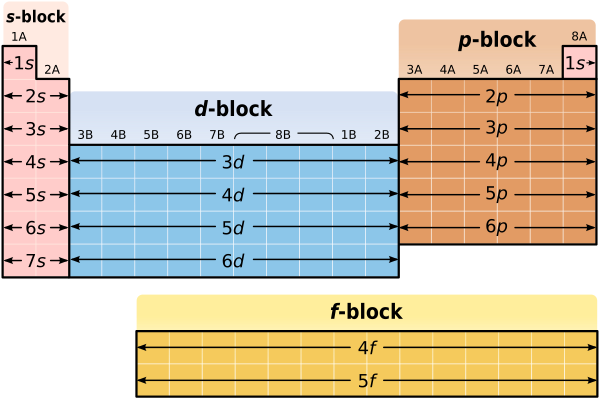
Note: Do not forget helium, an element in the s-block, that is hidden in the p-block.

Note: Do not forget helium, an element in the s-block, that is hidden in the p-block.
Sunday, February 28, 2016
Unit Quiz
Rules for Placing Electrons
There are three basic rules for placing electrons. They are listed below:
- Aufbau Principle: electrons enter orbitals of lowest energy first.
- Pauli Exclusion Principle: an orbital can only contain two electrons with opposite spin.
- Hund's Rule: within a sublevel, electrons enter singly before pairing up
Subscribe to:
Posts (Atom)